Shop LEDSupply for Free Shipping and low prices on high-quality LED Strip Lights, Tape Light, AC Strips & More. In stock. Click or Call (802) 728 6031.
Shop LEDSupply - Free Shipping & the lowest prices on LED fixtures and bulbs for retrofit lighting applications. In stock. Click or Call (802) 728 6031.
Shop LEDSupply - Free Shipping & the lowest prices on LED accessories like Arctic Silver, LED Seal, Connectors, Switches & more. In stock. Click or Call (802) 728 6031.
LED Strip lights are becoming more and more popular for home lighting. More than likely you have heard the argument for LEDs over incandescent and even halogen bulbs: they are more efficient, brighter, longer-lasting, they don’t produce much heat, they are easily controlled and programmed…the list goes on and on. LEDs come in extremely compact packages that are durable and resistant to shock, making them so they can be used in a variety of designs both big and small.
One increasingly popular way is in LED strip lighting. Linear (strip) lighting has become very popular and is an affordable option for both commercial and residential lighting applications. Buying LED strip lights might seem relatively straightforward, but there are many things you need to consider in making sure you get the right type of light for your needs. Follow through this post as we walk through the important factors for LED strip lighting and run through our main LED light strip categories.
Types of LED Strips
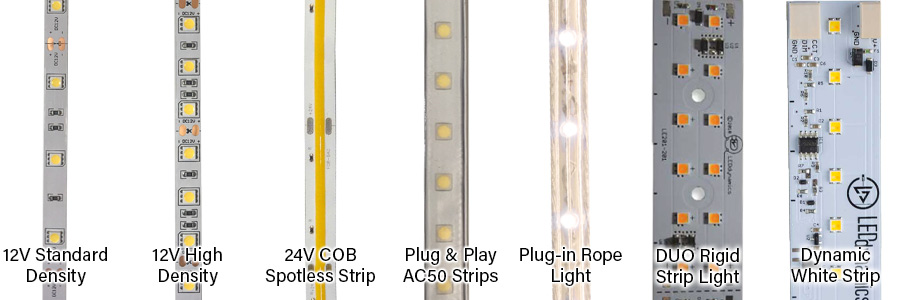
The LED Strips category is a broad category that includes all different types of LED strip lights. Depending on how you plan to use the LED strips, you may need one type over the other. For example, IP65 LED flex strips are better suited for outdoor and wet areas as they have a protective covering that makes them waterproof. Below is just a brief description of each kind of LED Strip Light, this guide will go into more detail on them later as there are multiple strip options in most of these categories.
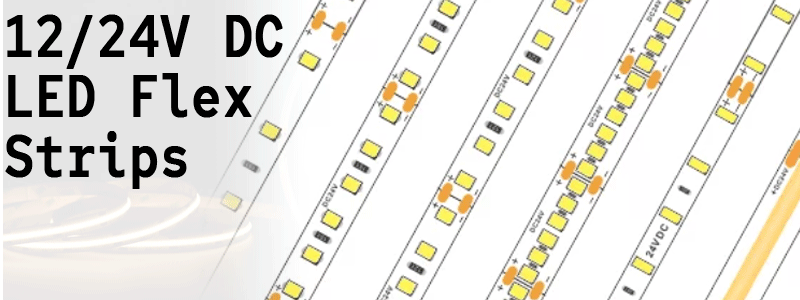
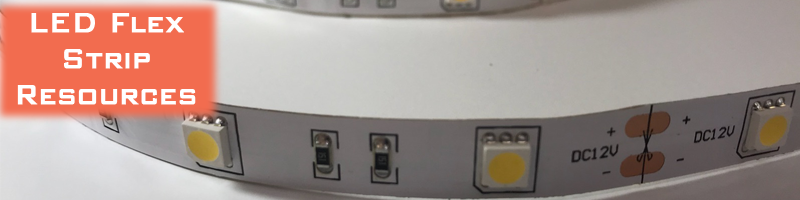
DC LED Flex Strips – Strips that run straight from a low DC voltage, typically 12-24V. These flexible strip lights have an adhesive backing for easy mounting and can be cut every two inches. They are offered in a wide range of light outputs and waterproof protection.
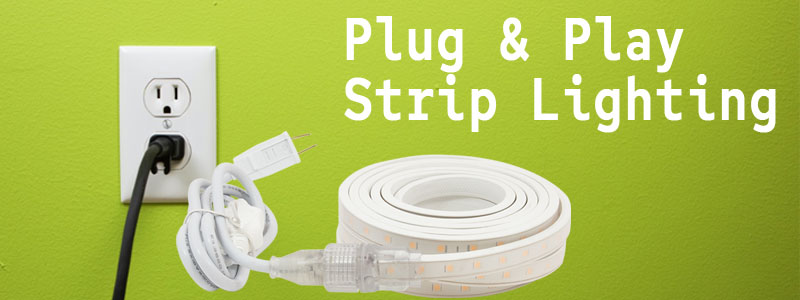
AC Plug & Play LED Strip Lights – Flexible strip lights that run straight from your outlet. Just plugin and they are ready to go. These strips can run in much longer straight-run lengths than DC Flex Strips…all the way up to 150 FT!
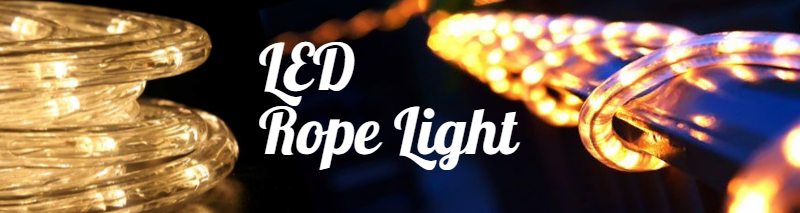
LED Rope Light – Encased, Omni-directional LEDs in the standard rope light packaging – very dim output meant for accent lighting, also plug & play!
High Output LED Strips – Rigid strip lighting that houses mid to high-power LEDs from top manufacturers like Cree, Nichia, and Luxeon! Designed and manufactured in the USA with onboard drivers so they work with straight 24V DC input.
LEDs/length
When buying LED strip lights, it is important to look at the number of LEDs per length. For brighter output and higher light quality, you should look for the strip lights that have the highest number of LEDs per Foot (Meter, Yard, etc). If LEDs are spaced too far apart across the strips they could produce spotty lighting instead of a clean, constant line of light. It can be confusing as manufacturers use different units of measurement to advertise this. My recommendation would be to stick to a certain measurement and then convert all other measurements to see what strips have the most LEDs per set unit of measurement.
Take note that LED density is not the only factor in determining brightness and light quality. Our LED Rope Light, for instance, has more LEDs per foot than our DC LED Flex Strips but they are low output LEDs that produce only a fraction of that on the flex strips. Therefore, the Rope light is far spottier than any of the Flex Strips on our site, so always check on the brightness of the LED strips as well.
LED Strip Brightness
As LED technology continues to improve, LED strips continue to reach brighter capabilities. This does not mean all strips will be super bright… in some cases, you may not even want the light to be bright. An example of this would be accent lighting within a shelf.
The brightness of LEDs is measured in LUMENS. Depending on how you are using the LED strips, you will probably want a certain level of lumens.
For accent lighting, you will probably not need anything brighter than 200 Lumens per foot but there is no exact rule here, it is all about personal preference and the feeling/mood you are going for.
When using LED strips for general lighting purposes within a room it becomes a bit trickier. Brightness needs will depend on the light direction, its distance from your subject (the area you plan to illuminate) as well as personal preference.
Make sure you take note of the Lumens/length along with the LEDs/length of each strip you research as this will have a strong effect on light quality and the type of light the strip gives off.
LED Strip Colors
Our LED strip lights come in a wide range of white, single colors as well as multi-color strips (RGB or RGBW). The most basic LED strip lights are our single colors that only emit one fixed light color. We offer them in: Warm White, Neutral White, Cool White, Red, Green, Blue, Yellow, Pink, and Ultra Violet (UV).
The color-changing strips are called RGB strips. The color-changing strips use multi-colored LEDs so that they can change colors to your liking. RGB Strip lights are the most common color-changing lighting we carry. These LED lights can display any Red-Green-Blue combination color.
The one color RGB lights can’t create is white. That is where RGBW strip lights come into play. The LEDs on the strip alternate between RGB and White diodes so that the light can produce multi-color effects but also a normal white for when you need it.
Color Temperature
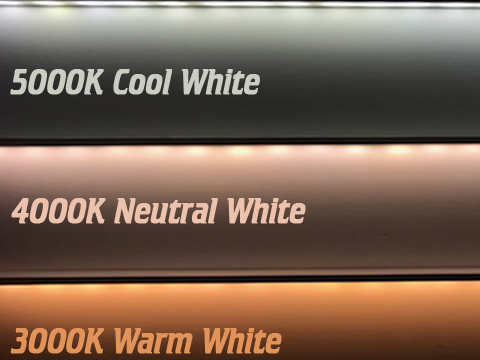
Color temperature is how we differentiate the various white colors that an LED can produce. Temperature indicates how ‘warm’ or ‘cool’ the light appears. Temperature is measured in Kelvin with higher temps representing cool colors (blueish hue) and lower temps representing warmer colors (yellowish light you would expect from a bulb). See below for a more visual explanation.
Tunable white lighting is becoming a very popular trend in lighting. This type of strip will offer multiple CCT colors on one strip and require a special controller much like RGB lighting. Instead of making vibrant colors across the rainbow, tunable white lighting can transform the feel of your room from a 2700K Warm White all the way up to a 6500K Cool White. We go over our tunable white lighting options in-depth in our Tunable Lighting Guide.
Installation of LED Strip Lights
Before buying LED strip lights, it helps to have a clear idea of how they will be mounted, powered, connected, and controlled. Some installations are as simple as removing the adhesive backing and mounting the strip to a clean surface, while others require cutting, wiring, connectors, channels, multiple power feeds, or waterproof connections.
Before starting, consider:
Total LED strip length required
Number of separate runs or breaks in the installation
Strip voltage and power requirements
Required flexibility and bend direction
Indoor, waterproof, or high-temperature protection
Connectors, wire, channels, and other installation accessories
How the strips will be dimmed, controlled, or programmed
Planning a project now? Our 8-step guide to choosing the right LED strip lights walks you through the key decisions for your installation. At the end, you can send us your project details so our team can review them and help recommend the right strips, power supply, controls, and accessories.
LED Strip Wattage
Another key factor in setting up your LED strips is knowing the wattage. First, you need to find out the wattage of the system you want to set up. Here at LEDSupply, we provide you with the wattage per length of strip so it is easy to find what your total wattage will be once you know how many linear feet you have. Finding total wattage will not only help you find an adequate power supply but will also let you know how much electricity you will be using with your new lighting setup.
Once you know the total wattage you are ready to find a power supply. You will need a power supply for all our strips other than the Plug & Play options (AC5050 Strips and LED Rope Light). Plug and play strips have a power cord built onto them with a switching transformer in line so there is no need for an additional power supply.
The first thing when looking for a power supply is knowing what input voltage your LED Strips require. The strips found at LEDSupply can be either 12V or 24VDC powered…just make sure you know what your strip needs and find a power supply with that output. Secondly, make sure the wattage of the power supply is at least 10% higher than the wattage your LED strips will consume. If there is no wattage listed on the power supply (there always will be on our site) it is a good thing to note that: Output Voltage x Amperage = Wattage of your power supply.
Buying LED Strips at LEDSupply
Now that we have gone over some of the basics of buying LED strip lights, it is time to look at the specific strips we carry. In the rest of the post, I will go over each strip in hopes to help you decide what strip is best for your application. This is the most important section of this post as it will help you find the strips best for your needs and will have all the info you need to set them up and complete your project.
DC LED Flex Strips
These 12-24 volt flexible LED strip lights are the most popular product for in-home lighting DIY projects and renovations. Thousands of customers and contractors just like you find these lights extremely helpful for both task and accent lighting around the home. There are a lot of complimentary accessories offered as well to make these strips very user-friendly.
What makes them so easy to use?
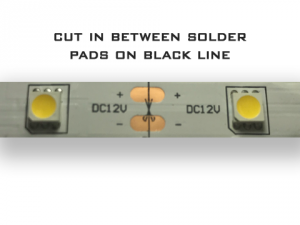
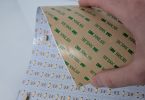
The strips are made with 3M double-sided adhesive backing for easy installation. Secondly, they sit at an extremely low profile. The strips themselves produce little heat so are perfect for tightly spaced applications. The strips are offered in 3-foot increments up to a full reel which is 16.4 ft (5 Meters) but they have cut lines along the strip for you to cut to more precise measurements.
DC Powered
The strips will take either 12 or 24 VDC input. The low voltage lighting makes it safe to set up for novices. Not only does it make the wiring and connections safer than straight AC line voltage but it also makes it so you can power them directly from batteries and solar systems! When powering in the home, just make sure you use a power supply or transformer that will change your AC line voltage to a safe DC voltage.
Waterproof Strips…or not
These flex strips are offered in three different styles of the strip. The flex strips most basic, bare-bones design is the IP20 style that is a flexible printed circuit board housing with no protective coating. These strips are great for areas where you don’t need to worry about any water or dust ruining the strip and electrical components.
The IP65 Waterproof LED strips are the IP20 base strip with a thin silicone layer on top of the flexible strip, these LEDs can withstand the elements. Waterproof strips are recommended for outdoor lighting, patio lighting, bathroom lighting, and under cabinet lighting where moisture or dust can collect.
The best protection the strips come in is IP68 which can be fully submerged in water or kept in high heat environments like saunas or steam rooms. You can see how the steps up in protection also add to the size of the strip below.
Standard, High or Ultra-High Density
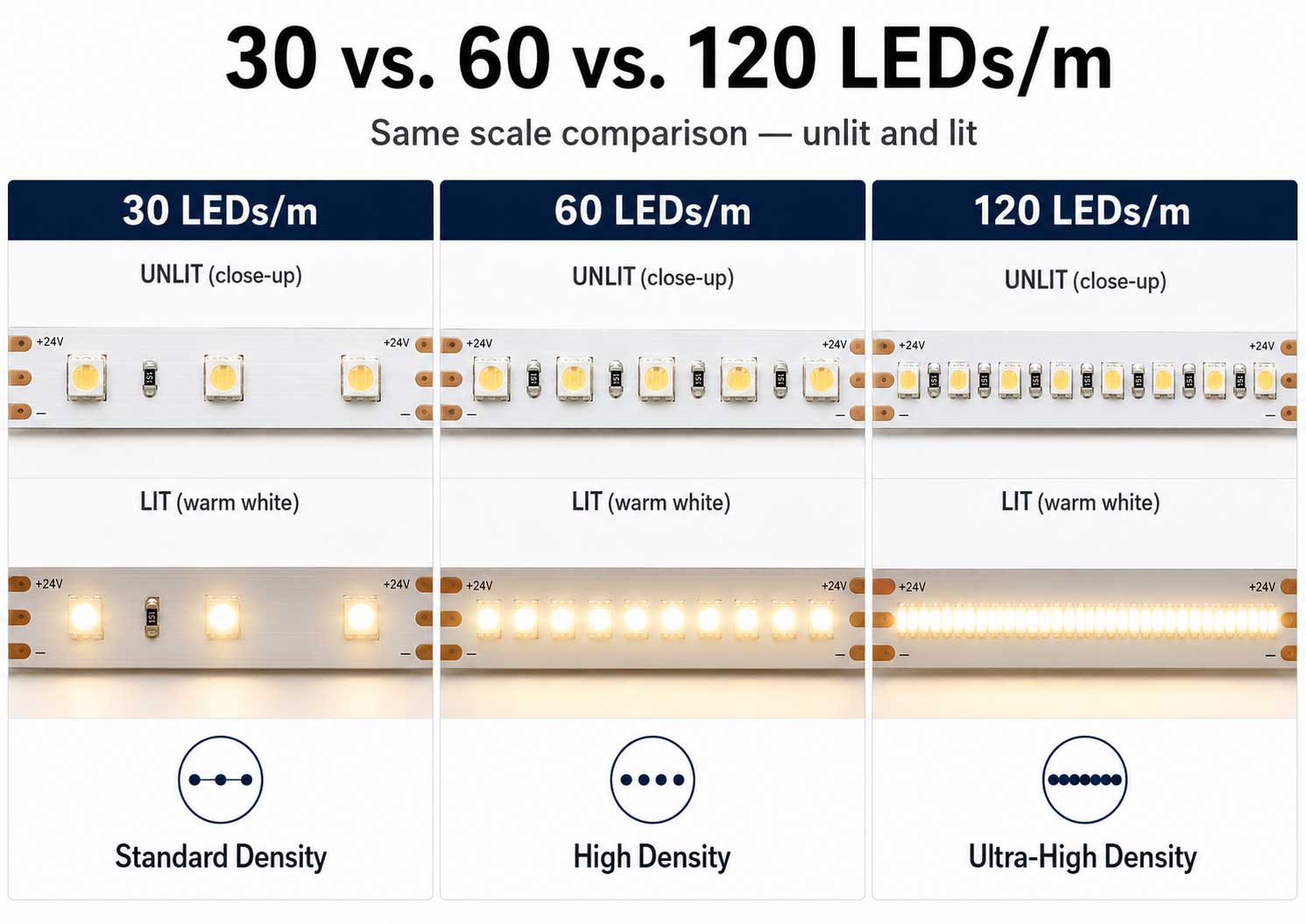
The standard DC flex strips have three different density options. The standard density strips have 30 LEDs/M, their brighter upgrade, the High-Density strips, have double the LEDs, 60 per Meter and the Ultra-High Density strips are 120 LEDs/M!
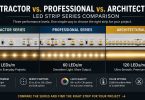
Understanding Our LED Strip Series
To make it easier to compare performance levels, we group many of our core LED strips into three series:
Contractor Series is built around practical, cost-effective lighting for everyday accent and indirect applications. These are typically our standard-density 30 LEDs/m strips.
Professional Series steps up to higher-density 60 LEDs/m options for stronger output and a smoother finished appearance in under-cabinet, cove, display, task, and other finished lighting applications.
Architectural Series includes our most refined strip options, such as ultra-high-density 120 LEDs/m products, COB, 95+ CRI, premium white color temperatures, and tunable white. These are designed for projects where light quality, uniformity, and the finished appearance matter most.
The series are best thought of as performance levels rather than different types of LED strip. A white, RGB, waterproof, or 24V strip can still be chosen based on your application; the series simply help indicate the level of performance and refinement available.
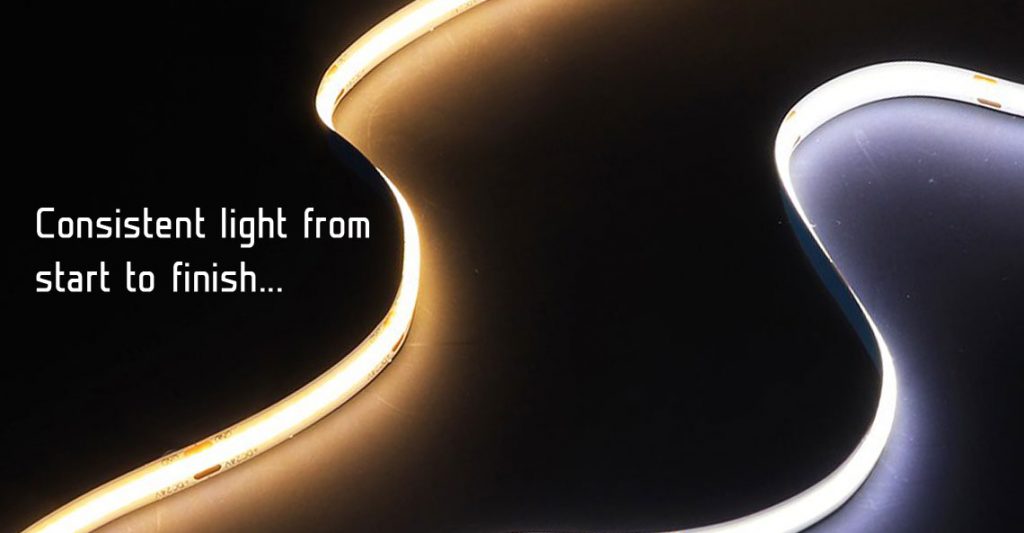
Premium strip offerings like our COB Spotless Strip lights and Tunable White Strips have up to 512 LEDs/M and produce a seamless source of light with no spots. These are great for high-profile lighting projects and especially excel when the lights are around reflective surfaces like granite or glass.
Obviously, those looking for the brightest light should migrate to the Ultra high-density strips but be careful to look at the differences between the options in the table below.
Density
# of LEDs
Lumens
Wattage (per Reel)
Cuttable
Max. Run
Stand. (SD)
30/Meter
540/M
27 Watts
Every 4″
32.8 Ft.
High (HD)
60/Meter
1080/M
40 Watts
Every 2″
16.4 Ft.
Ultra (UHD)
120/Meter
1890/M
Every 1″
16.4 Ft.
Standard Density flex strips are great for use in tight spaces or when used for indirect, accent lighting. They are clearly not as intense as the higher density so they are better for the applications where less light is more. Examples of this are shelf lighting, backlighting, and stair lighting.
The one big advantage of the 30 LEDs/M Strip is they can be connected end to end up to 32 ft…DOUBLE that of the high density. This is a definite benefit to the lights, helping those decide that need longer lengths and don’t care as much about the brightness.
Remember how we talked about light quality earlier and how it depends on the brightness of the LEDs as well as LED density (LEDs/M)? Well, the high-density strip uses the same exact diode on the strips but double the amount, therefore delivering a quality light much more powerful than the standard density strips.
The high-density strips are a significant upgrade from the standard density if you are looking for more light output. These are mainly for those applications that have higher ceiling coves and you need more light or if you are using them as a main source of light in a specific area. The light output is fantastic for task lighting of all kinds and you will probably even want a dimmer to adjust down when needed.
12 & 24 volt LED flex strips are super simple to use. There are many options, however, that can make the task seem overwhelming to some. If this LED strip interests you and you would like to learn more about setting this up yourself then follow our Guide to Installing LED Strip Lights. This guide is specific to DC Flex Strips and goes over all the information and helpful accessories you will need to set up your lights!
AC LED Flex Strips
Perhaps you want to just plug something in and go, if that is the case the AC Plug & Play LED Strip Lights are just for you.
These strips are slightly wider than the DC powered strips, sitting at 9/16″ wide and 1/4″ tall. Don’t worry about the size increase as these pack a lot of light with 20 LEDs per foot giving off 180 Lumens in that span. The best part? These are plug-and-play strips, just buy the length you want, plug into a wall receptacle, and these babies are ready to go!
The other big advantage of this style is that they can run in continuous lengths up to 150 feet!! This makes it so you can run longer lengths without any issue. The strips cannot be cut in the small intervals that the DC Flex strips can but they can still cut every half-meter. If you have a gap in your application you can easily choose a strip-to-strip jumper to fit the gap and keep your light going seamlessly.
The mounting isn’t quite as easy as the DC flex strips as they do not come with adhesive backing. Luckily they come with mounting clips (1 per 3 feet) to mount to the surface. For those not wanting to deal with clips or want the LED strip in a very tight, straight application the 3-foot mounting tracks would be a good choice to set the LED strips up.
If you are running longer lengths (75′ and up) it will be a good idea to consider AC LED strips. These strips run much better over distance and there won’t be the need to purchase multiple power supplies and dimmers as they can run straight from 110-120AC line voltage. Take a look at our AC5050 Review which goes into further detail on using these strip lights.
LED Rope Light
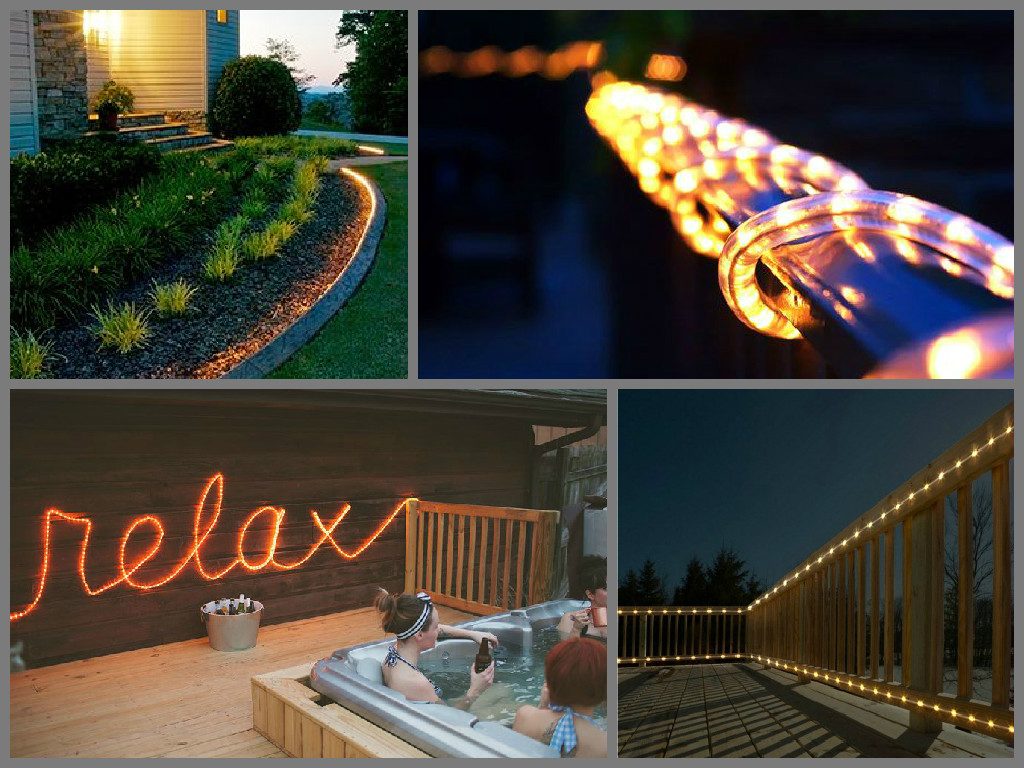
Alright, we have moved past flex strips now and are into a slightly different type of linear LED, LED rope light. Unlike the flat, ribbon-like flex strips, this LED Rope light is encased in a 1/2” diameter round rubbery plastic. The encasing makes for a waterproof rope light that can bend in all directions and has Omni-directional LEDs. This means that, unlike the LED Flex Strips that emit out the top, these LED Rope Lights emit all around the whole rope, there is no backside or area where you cannot see the light. The Rope Light is not nearly as bright but works great for dim accent lighting or just a nice added touch to your outside deck, patio, garden, etc.
This LEThis LED Rope Light is like the AC LED Flex Strips in the sense that it can plug straight into a standard wall outlet and run from 120VAC. They give off no heat and run off of very little power as they are only .77 watts per foot. The LED Rope Light is offered in warm white, cool white, and blue.
The rope holds 12 LEDs per foot with an inch in between each. The lumen output is extremely lower than our other linear options at 6.3 lumens/foot for cool white and 5.5 lumens per foot for warm white. We offer the Rope Light in custom-cut lengths of 3, 9, 15, 30, 75, 105, and 150 feet. Like the AC LED Flex Strips the Rope Light can be connected with jumpers but can go all the way up to 150 feet in length. With every 3 feet of rope light purchased, we include a clip for mounting them wherever you’d like. These ropes look like a typical rope light in the sense that you can tell where each LED is placed, it is not meant to be a steady, smooth light all the way through. The light that comes off is great for accenting certain areas but is not enough to be the stand-alone lighting for a room.
This Rope Light is a great value and has a rated lifetime of 60,000 hours for whites and 100,000 hours for colors. They are extremely durable and add a nice touch to your spot. Use them in places where you don’t want a bright light or just need something to draw attention to a part of your house or outside area. Take a look at the pictures above to see how they are typically used.
Linear LED Boards & High-Output Light Engines
This final category includes our brightest strip lights. Unlike the flex strips and rope light above, these strips have mid to high power surface mount LEDs on a more rigid strip.
The Duo Strip
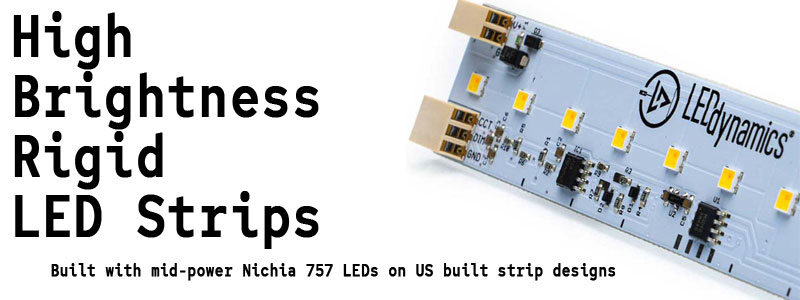
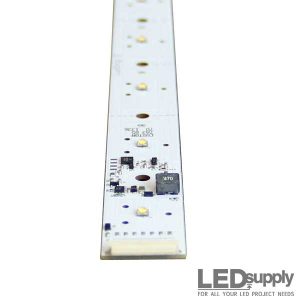
The Duo LED strip is manufactured right here in the United States by LuxDrive. If you want to make your own LED linear fixture this is your light engine to start with. The Duo houses 48 Nichia 757 diodes on a 1-foot by 1-inch printed circuit board (PCB). There are onboard drivers that keep the LEDs safe while requiring only a 24V input. Each 1-foot Duo Strip runs at about 8 Watts while outputting over 870 Lumens!
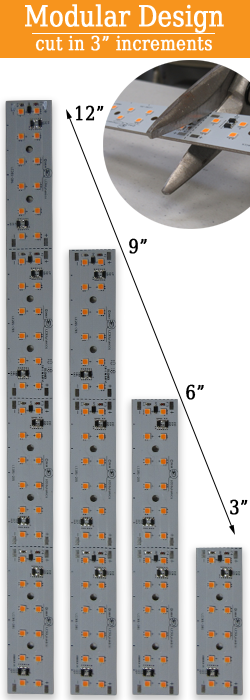
The Duo can be cut down into smaller segments for design flexibility. Every 3 inches there is a dashed cut-line showing where it can be cleaved into separate pieces with a circuit board cutter (paper cutters work as well) or shears.
The strip segments, whether cut short or full foot lengths can be connected up to 8 feet at a time. That means 8 full Duo strips can be connected in series off of the same power source. If you cut the strips down smaller, just make sure your total LED strip length does not exceed 8 feet.
The Duo is offered in a wide color temperature (CCT) range from 2700K to 6500K. If you need color the Duo has that covered with red, yellow, green, and blue.
Believe it or not, there are even horticulture-specific LEDs that come on the duo. The Nichia 757 Horticulture options are available in both 3000K and 5000K. These LEDs have a very wide output spectrum that is perfect for growing applications.
Tunable White 24V Linear LED Board
For projects that need adjustable white light, this rigid 24V board uses 2-in-1 Nichia 757 LEDs and allows continuous tuning from 2700K to 6500K. It is a good option for fixtures and architectural applications where both warm ambient light and cooler task lighting are needed from the same light engine.
Best for: tunable fixtures, hospitality, retail, task lighting, and architectural systems.
For applications that need substantially more output, LUXblast is a compact 10-inch rigid LED strip built around Cree XLamp XHP35 LEDs and capable of more than 7,000 lumens. Optional optics allow the beam to be controlled for longer throw and more focused illumination.
Best for: vehicles, equipment, high-output task lighting, specialty fixtures, and applications where maximum brightness is the priority.
LUXshift provides a different type of dynamic white control. Rather than simply adjusting brightness, the strip shifts from a cooler 6500K appearance toward a warmer 2700K as the light is dimmed, creating an effect similar to traditional incandescent lighting.
Best for: hospitality, residential fixtures, architectural lighting, and applications where warmer light at lower dim levels creates a more comfortable atmosphere.
When Should You Use a Linear LED Board Instead of Flexible Strip?
Flexible LED strip is usually the better choice when the installation needs to bend, follow curves, or fit easily into channels and irregular spaces.
Linear LED boards make more sense when you need:
A perfectly straight light source
A rigid mounting platform
Better thermal performance
Professional optical control
Higher output
Integration into a fixture or OEM product
More precise mechanical alignment
If your project falls into that category, explore our full Linear LED Boards selection to compare voltage, color temperature, output, dimming, and application options.
The Ultimate Guide Wrap Up
That about does it for our run-through of LED strip lighting. Buying LED strip lights does not have to be a difficult process as long as you know what to look for. The key for you when buying LED strips is to make sure you know your application and area restrictions and then understand your options for installation, power demands, and colors. With our range of strips and options, you will find what you need for your lighting project. Remember we are always here to support you along the way via email (sales@www.ledsupply.com) and phone (802-728-6031). As always feel free to share what you’ve done with our strips on our social media pages, we love seeing what is done with our LEDs and it helps provide inspiration for those unsure of the power and greatness of LEDs.
Marketing and technology enthusiast helping pave the way to a more energy-efficient society. Living in the beautiful state of Vermont and working for a company like LEDSupply that is helping provide LED products to save on energy is a great place to be to accomplish this. Always exploring and staying active outdoors while keeping a close eye on different trends and new technologies that could change the world for the better.
Hello. I’m looking for battery powered LED strips. I’d like to use them to illuminate my rolling cart contains my toolbag. I would fasten them under the shelf above my tool bag, on my cart. Thank you!
Hey Greg,
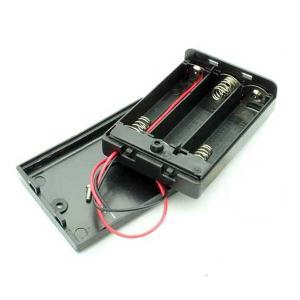
Our Flex strips are actually able to be battery powered, you would just need a 12V source. 8 AA batteries in series would do the trick or there are other battery packs that can be found that give off 12V as well.
















Hello. I’m looking for battery powered LED strips. I’d like to use them to illuminate my rolling cart contains my toolbag. I would fasten them under the shelf above my tool bag, on my cart. Thank you!
Hey Greg,
Our Flex strips are actually able to be battery powered, you would just need a 12V source. 8 AA batteries in series would do the trick or there are other battery packs that can be found that give off 12V as well.