







Color Name & Wavelength
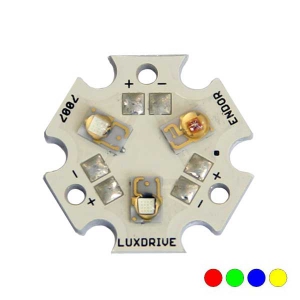
Use the published nanometer range when color precision matters. Current visible options include red, green, blue and yellow wavelength bands, plus pink where a wavelength value is not published.



 ,
Operating Voltage ,
IP Rating ,
Color (nm) ,
LED Density (LEDs/M) ,
Power Consumption (W/ft) ,
Maximum Run Length (ft) ,
Cutting Interval (Inches) ,
Strip Width ,
Narrow your choices
,
Operating Voltage ,
IP Rating ,
Color (nm) ,
LED Density (LEDs/M) ,
Power Consumption (W/ft) ,
Maximum Run Length (ft) ,
Cutting Interval (Inches) ,
Strip Width ,
Narrow your choices
Compare wavelength, output, voltage, density, power, IP rating, run length and cut interval—from SMD and dot-free COB to long-run 120V and specialty UV.
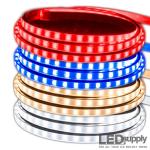
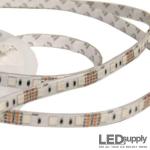
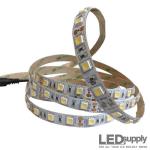
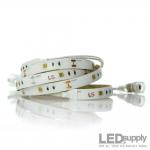
A dedicated-color strip provides one fixed spectral output without RGB mixing. Start with the required color or wavelength, then specify the electrical, optical, physical and environmental requirements of the complete system.
Use the published nanometer range when color precision matters. Current visible options include red, green, blue and yellow wavelength bands, plus pink where a wavelength value is not published.
Use lumens per foot for visible light where published. UV sources require wavelength and radiometric data such as radiant flux or irradiance; lumens are not an appropriate UV performance metric.
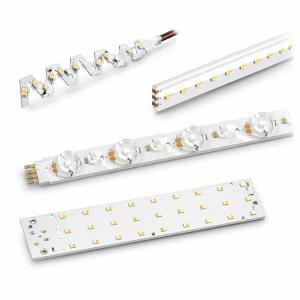
Standard- and high-density SMD strips balance cost and output. The 512 LEDs/m COB strip creates a continuous, dot-free line of red, green or blue light with a wide 180° viewing angle.
Match the strip, power and dimming platform exactly. The primary SMD strips use 12V, COB and UVC use 24V, and the plug-in product supports long 120V runs without a separate DC supply.
Size power from the published load-by-length data where available and include appropriate headroom. Confirm dimmer type and capacity, wire gauge, maximum run and any parallel-feed requirements.
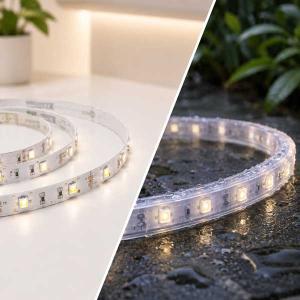
Match IP20 or IP65 construction to the exposure, then confirm finished width, mounting method, cut points, connectors and field-sealing requirements before finalizing the layout.
These products occupy different spectral regions and should not be compared by color name or brightness alone.
The current range covers value-oriented SMD tape, higher-density output, dot-free COB, long-run plug-in lighting and two distinct ultraviolet platforms.
For cost-conscious waterproof accent, display, signage and decorative lighting in one dedicated color.
For stronger output and closer LED spacing where color intensity and visual uniformity carry more weight.
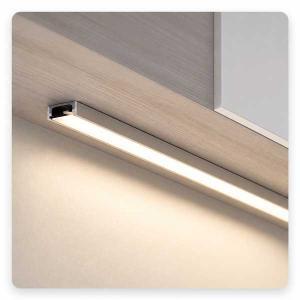
For refined interior details where the light source may be visible or a continuous, hotspot-free line is important.
For long architectural outlines, commercial accents and signage where direct plug-in operation simplifies the power architecture.
For blacklight effects, fluorescent displays, artwork, inspection and other indoor applications requiring near-UV output.
A specialized 24V source with 400nm UVA and 280nm UVC peaks for engineered ultraviolet applications—not general or decorative lighting.
Dedicated color is simpler and more efficient when the required hue never changes. Choose a multi-channel product only when the application requires adjustable color or white light.
Choose one dedicated spectral output with straightforward power and optional single-channel dimming.
Shop this category →Choose RGB when the installation must mix colors or run synchronized color-changing effects.
Shop RGB strips →Choose RGBW when the same strip needs full-color effects plus one purpose-built white channel.
Shop RGBW strips →Choose white strip when CCT, lumens, efficacy and color rendering matter; choose tunable white for adjustable CCT.
Shop white strips →The strip is one component. Confirm voltage, load, control method, wiring, dimensions and environmental requirements across the complete installation before ordering.
Use a constant-voltage supply that matches the 12V or 24V strip and is sized for the published load plus headroom. Use the specified plug-in hardware for 120V.
Use compatible PWM dimming on low-voltage visible strips or a verified AC dimmer for the 120V product. Specialty UV control requires application-specific safeguards.
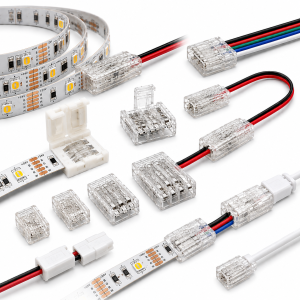
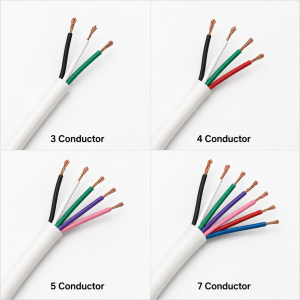
Match voltage, polarity, strip width, connector type, wire gauge and IP rating. Plan every cut, jumper, branch and parallel feed before installation.
Choose channel, diffuser, clips, track or adhesive for the required finish and support. Restore environmental protection at field cuts and connections.
Use these LEDSupply guides to plan the strip, power, mounting and complete installation before ordering components.
A single-color strip uses a dedicated light source for one fixed hue and does not require a multi-channel RGB controller. It is the simpler choice for signage, accents, displays and other applications where the required color will not change.
Names such as red or blue describe broad visual categories. A published wavelength range identifies the emitted spectral band more precisely, which matters for brand color, fluorescence, inspection, sensing and other technical applications.
No. Human vision responds differently across the visible spectrum, so equal electrical power does not produce equal lumen values in different colors. UV output should be evaluated with wavelength and radiometric data rather than lumens.
The UVA strip operates at 395–405nm near the visible violet edge and is intended for blacklight and fluorescence applications. The UVC product has a 280nm peak and is a specialized ultraviolet source requiring much stricter exposure controls. The products are not interchangeable.
No. UVC can seriously damage eyes and skin and must not expose occupants during operation. It requires qualified system design, shielding, access control, warning measures and appropriate protective equipment. Review the complete product safety information before purchase or operation.
Choose Contractor Series for value-oriented 30 LEDs/m visible color, Professional Series for higher-density 60 LEDs/m output, and Architectural COB for a continuous dot-free line of red, green or blue light. Then confirm voltage, IP rating, output, cut interval and maximum run against the project.
Select voltage as part of the complete system architecture. The visible SMD strips use 12V, COB and UVC products use 24V, and the 120V plug-in product is designed for continuous runs up to 150 feet. Never connect a strip to a different voltage than its published rating.
The current low-voltage visible-color strips are PWM dimmable with a compatible dimmer. The 120V strip can work with many compatible AC dimmers, subject to minimum-load and compatibility requirements. Do not assume the same control method applies to specialized UV systems.
Most products can be cut only at their marked cut points, and the interval varies from about 2 inches to 19.7 inches. Stay within the published maximum run, use compatible connectors and power feeds, and properly reseal field cuts wherever IP protection must be maintained.
Use the product's measured power-by-length data where available, total the loads of all connected runs and add the recommended capacity headroom. Also confirm wire gauge, dimmer capacity and voltage drop before finalizing long or multi-run installations.




Orders received before 3PM EST will be safely packaged and quickly shipped the same business day. If your order is NOT shipped the same business day, LEDSupply will offer a 5% discount off your next order.
All orders SHIP FROM:
296 Beanville Road
Randolph, Vermont 05060
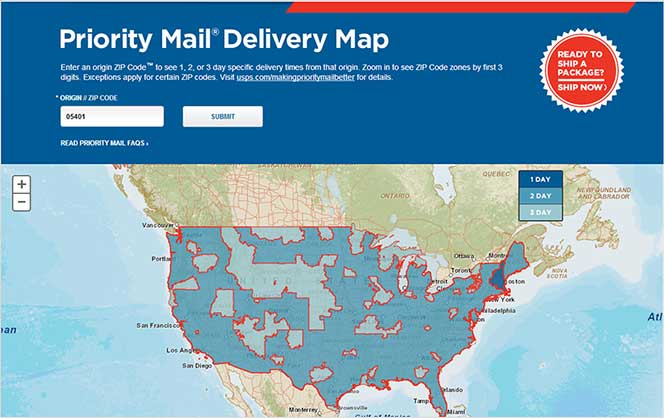
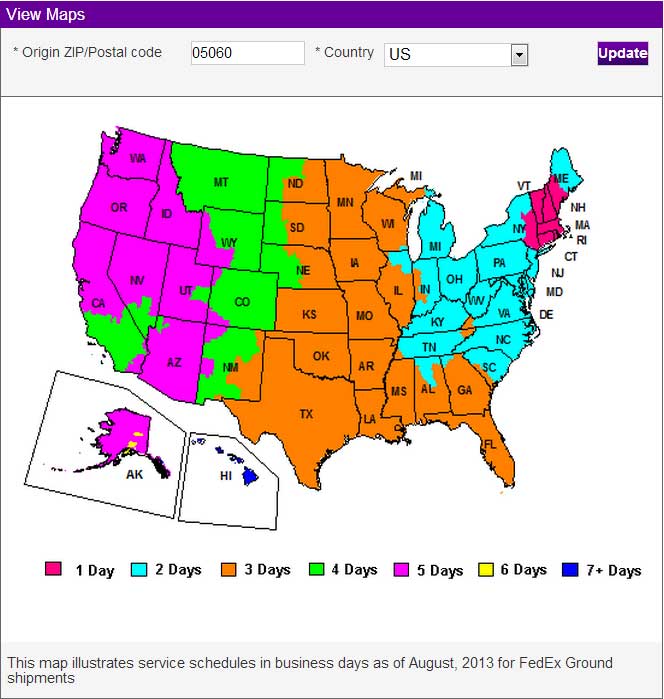
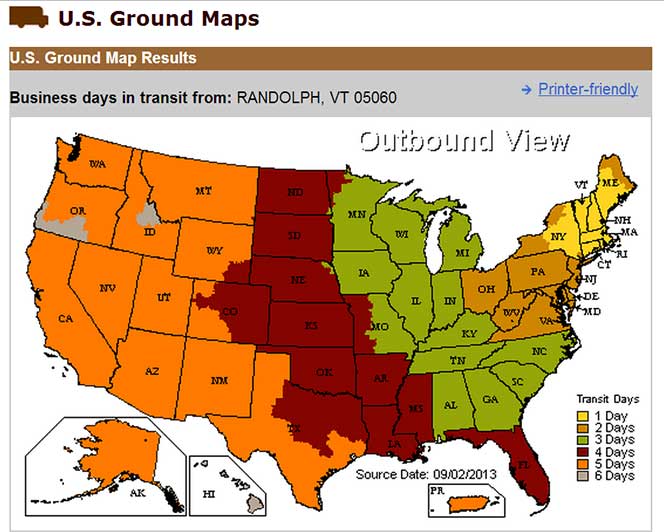
See respective ZONE maps below for SPECIFIC delivery time to your location:
Any order that does not qualify for free shipping, will by default include a discount of equal value to the free shipping offer.
The shipping offered is meant to provide the widest variety of shipping options at the lowest price: