

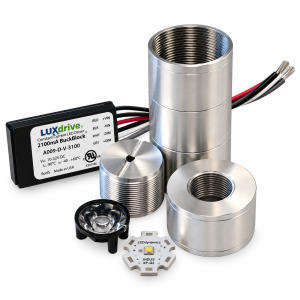


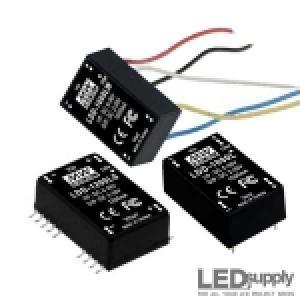
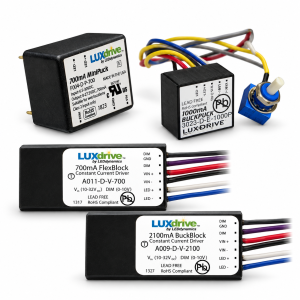






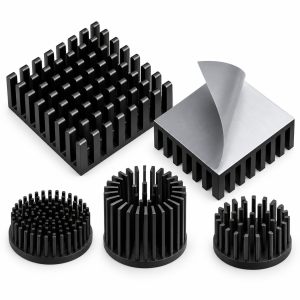
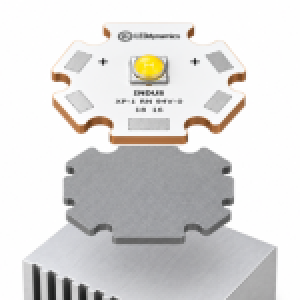


LUXdrive® BuckPuck 3021 Constant Current LED Drivers - 7-Pin SIP


More images


- Low-Voltage DC Constant Current Device
- MADE IN USA
- Multiple dimming options
 CONFIGURE & BUY
Purchase
Ordering for a larger project?
Ask about volume pricing
| VOLUME DISCOUNTS | ||||
| QTY | 10 - 49 | 50 - 99 | 100 - 249 | 250 - 499 |
| % OFF | 2.5% | 5% | 7.5% | 10% |

Product Details
| Output Current (mA): 350, 500, 700 & 1000 | Input Voltage Range (DC): 5-32VDC |
| Connection Type: Pin SIP or Wires | Compliant: RoHS |
| Dimming: 0-5V | Output Protection: Short & Open Circuit |
| Input Protection: Reverse Polarity | Small Form Factor: 0.83"(L) X 0.83"(W) X 0.43"(H) |
| Potentiometer Control: 0-100% Intensity | External Control: Analog/Digital Intensity Control (TTL Compatible) |
| Efficiency: 90% | Optional Control: On-Board Trim Adjustment (40-100%) & 5K Pot |
Description
The USA made LUXdrive® 3021 (7-Pin SIP connection) BuckPucks by LEDdynamics are super compact, efficient, reliable and easy-to-use DC LED drivers, making them the ideal choice for powering all types of high-brightness and high-power LED arrays. The BuckPuck is self-contained and designed to match its output with the electrical characteristics of the LED(s). This avoids damage or thermal runaway to the LED as the BuckPuck compensates for changes in forward voltage while delivering a constant current to the LED.
Connection & Mounting
The BuckPuck is available with pin or wire leads. The 3021 series uses a 7-pin SIP connection for through-hole PCB mounting or for use with an optional wiring harness and the 3023 series uses 6” 24AWG wires leads.
Control & Dimming
BuckPuck LED drivers exhibit high efficiency and require no external current limiting resistors or additional heat sinking for operation. For applications where flashing or strobing of the LED(s) is required, the 3021/3023 BuckPuck includes a fast response current-sensing circuit as well as optional external dimming (0-100%) and on-board trim adjustment (40-110% 3021 BuckPuck Only). Included is an external DC analog voltage intensity control, TTL/CMOS logic level on/off control, and a built-in regulated 5V reference providing output to power logic circuitry or a microprocessor, eliminating the need for an additional power supply.
'P' Model BuckPuck w/ Potentiometer: The 03023-D-E-xxxP model has a 5k potentiometer already attached along with the other wire leads. This version makes it super easy to control the light for your small lighting system!
Even though the BuckPuck is listed as 0-5V dimming it was designed to work with LUXdrive's 0-10V dimmer!
Constant Current Output:
All the versions of the 3021 & 3023 BuckPuck are available in 350mA, 500mA, 700mA and 1000mA outputs.
Part Numbers, Images & Notes
For specific images and part numbers please select the options and the part number and image will automatically change; more details are included in the specifications and documentation below, but feel free to contact us should you have more questions. If you want to learn more about LED drivers and the selection process there is an informative post on our site, titled: 'Understanding LED Drivers and How To Choose the Right One'.
Technical Documentation
3021 Pinned BuckPuck Product Selection
| Part Number |
DC Input (VDC) | Output | Control Dimming (V) |
Connection Type |
On-Board Trim 40-110% |
|||||
|---|---|---|---|---|---|---|---|---|---|---|
| Min. | Max. | Input Margin |
Current mA |
Tolerance (±) |
Efficiency (%) |
Voltage | ||||
| 3021-D-N-350 | 5 | 32 | 2.5 | 350 | 10% | 95 | Vin- 2.5V | No | 7-Pin SIP (4 Pins) | No |
| 3021-D-N-500 | 5 | 32 | 2.5 | 500 | 10% | 95 | Vin- 2.5V | No | 7-Pin SIP (4 Pins) | No |
| 3021-D-N-700 | 5 | 32 | 2.5 | 700 | 10% | 95 | Vin- 2.5V | No | 7-Pin SIP (4 Pins) | No |
| 3021-D-N-1000 | 5 | 32 | 2.5 | 1000 | 10% | 95 | Vin- 2.5V | No | 7-Pin SIP (4 Pins) | No |
| 3021-D-E-350 | 7 | 32 | 2.5 | 350 | 10% | 95 | Vin- 2.5V | 0-5 | 7-Pin SIP (6 Pins) | No |
| 3021-D-E-500 | 7 | 32 | 2.5 | 500 | 10% | 95 | Vin- 2.5V | 0-5 | 7-Pin SIP (6 Pins) | No |
| 3021-D-E-700 | 7 | 32 | 2.5 | 700 | 10% | 95 | Vin- 2.5V | 0-5 | 7-Pin SIP (6 Pins) | No |
| 3021-D-E-1000 | 7 | 32 | 2.5 | 1000 | 10% | 95 | Vin- 2.5V | 0-5 | 7-Pin SIP (6 Pins) | No |
| 3021-D-I-350 | 7 | 32 | 2.5 | 350 | 10% | 95 | Vin- 2.5V | 0-5 | 7-Pin SIP (6 Pins) | Yes |
| 3021-D-I-500 | 7 | 32 | 2.5 | 500 | 10% | 95 | Vin- 2.5V | 0-5 | 7-Pin SIP (6 Pins) | Yes |
| 3021-D-I-700 | 7 | 32 | 2.5 | 700 | 10% | 95 | Vin- 2.5V | 0-5 | 7-Pin SIP (6 Pins) | Yes |
| 3021-D-I-1000 | 7 | 32 | 2.5 | 1000 | 10% | 95 | Vin- 2.5V | 0-5 | 7-Pin SIP (6 Pins) | Yes |
Absolute Maximum Ratings
| Parameter | Maximum Performance |
|---|---|
| Control Pin, adjustment threshold | 1.65V ±5% |
| Control Pin, shut off threshold | 4.2V ±5% |
| Control Pin, propagation delay to output | <15 micro="" s="" td=""> |
| Control Pin, input impedance | 1.5K ohm |
| Reference voltage (Vin=7V or great) | 5VDC ±5% |
| Optional trim pot adjustment range | 40%-110% |
| External pot adjustment range | 0%, 1-100% |
| Maximum flash frequency | 10kHz |
| Minimum Strobe pulse width | 50µs |
| Operating Temperature | -40°C - 80°C |
| Storage Temperature | -40°C - 125°C |
Important Information
Application Information: The 3021/3023 Wide Range LED Power Module is a high efficiency dc to dc converter which delivers a fixed output current by varying the output voltage as required to maintain the specified current. A fast response current-sensing circuit permits the unit to be used in applications where flashing or pulsing of the LEDs is required. Several options are available allowing for use with many types of LEDs and in a variety of operating modes
Fixed Current Drive: The fixed output versions of the 3021/3023 are designed to supply their rated current to one or more LED junctions. For example, a 350 mA rated unit will drive up to six white 350mA LEDs connected in series at 24VDC. Due to the nature of the buck regulator, the input voltage must always be higher than the total forward voltage drop of the LED junction(s) connected in series (2.5V for DC models, 4V for AC models). Thus, for a series string of six junctions having an average forward drop of 3.5V each, the required minimum input voltage will be 23.5VDC. A standard 24VDC power supply is a good choice for this application.
Adjustable Current - On-Board Control - "I" Model: Where the ability to adjust the output current to an intermediate value is required, all output current ratings are available with an on-board potentiometer. This permits the output current to be varied from approximately 40% to 110% of the rated value. When measuring the output is required to determine a particular set point, the following method is recommended:
- Temporarily place a 0.1 ohm, 1% resistor in series with the LEDs.
- Read the voltage across the 0.1 ohm resistor.
- The voltage, in millivolts X 10, will equal the output current in mA.
Because there is a small, high-frequency component in the 3021 output, many multi-meters may give an incorrect reading when used in the current mode. It has been found that the method described above yields a far more accurate measurement.
The potentiometers used for the on-board adjustable units are rated for a limited number of rotations (typically 100) and are intended for "set it and forget it" applications. Where frequent adjustments of output current are needed, the use of units with external adjustment capabilities is recommended.
Adjustable Current - External Control - "E" Model: Figures 10 and 11 show external adjustment configurations; both use a 5K ohm, linear taper potentiometer. In Figure 10, the potentiometer is connected between the internal 5VDC reference (Ref) output and the control (Ctrl) input. When using this configuration, it is important that Vin be 7VDC or higher. Figure 11 shows the control potentiometer being powered by an external 5VDC source. When using an external power source for the potentiometer, the source ground must be common to the LED output pin. In either configuration, connect the potentiometer such that clockwise rotation increases the resistance. Note that, because the current through the potentiometer is less than 5mA, a low power potentiometer may be used.
External On/Off Control: Where a manual on/off control is desired, the potentiometer in Figures 10 and 11 in the documentation may be replaced by a push-button or toggle switch. The output current will be zero when the switch is closed. Figures 12 and 13 show external dimming control combined with on/o control. The circuit in Figure 13 uses a 2N3906 or equivalent PNP switching transistor.
External Pulse/Strobe Control: Figures 14 and 15 show two methods for low speed pulsing or high speed flashing operation. In Figure 14, a 5V TTL/CMOS logic signal is applied directly to the control (Ctrl) input of the 3021. The output current will be zero when the control signal is high. Note that the input needs to source a minimum of 4.75VDC into a 1.5Kohm input impedance. Also, as is the case with a dc control signal, the logic input ground should to be common to the LED output terminal.
Figure 15 shows an inverted input configuration using a 2N3906 or other PNP switching transistor. In this case, a logic high will cause the output to be "on". In either configuration, the rise time of the output will be 10 seconds or less. A pulse frequency up to 10kHz may be used.
Microprocessor Control: Figure 16 shows a typical interface for a Microchip PIC® or similar controller. The reference output provides the operating voltage for the processor (5V at up to 20mA current).
Other Control Applications: In addition to the configurations described above, the 3021 may also be driven by a D to A converter. As in the cases above, the analog control signal should have its ground common to LED-. Figure 2 shows the effective control range of the analog input signal.
Connections: In all cases, the LEDs being driven should be located as close to the 3021 LED output as possible. When the use of long leads is required, use heavier gauge wire. For strobe or pulse applications, a wire length not exceeding 6" should be used to maintain accurate timing.
The power input wires/traces should also be kept short. Where DC input units are located more than 18" from the source, a 220mF, 50V capacitor should be placed across the input terminals as shown in Figure 18.
For applications where the use of header pins is inconvenient, a mating connector with 6" leads is available as an accessory, or the 3023 part number may be used, which is supplied with 6-inch colored leads.
- 3021HN - Harness for N type (4-wire)
- 3021HE - Harness for E & I type (6-wire)
- 3021HEP - Harness for E & I w/pot (6-wire w/pot)
Note: The above are product highlights and not the complete manufacturers datasheet. Please view the .pdf for complete specifications and images of all the figures referenced.
Full Documentation
 BuckPuck Documentation
Accessories
Wired BuckPuck Accessories
Single Color 20-24 AWG Stranded Wire for LED Lighting
BuckPuck Accessories
Aluminum Turn Knob
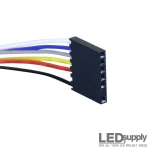
LUXdrive® BuckPuck - Wiring Harness with Dimming Wires
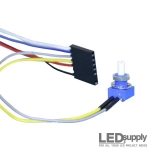
LUXdrive® BuckPuck - Wiring Harness with Dimming Wires and Potentiometer
FAQ
I've supplied just the right amount of voltage that I need for my LEDs, why isn't my LED driver operating properly?
With this BuckPuck LED driver their internal circuitry requires a 2 volt over head in order to run.
So if you have an 11 volt LED system, make sure you are applying 12VDC at the very least to the constant current LED driver.
This BuckPuck is listed as 0-5V dimming, can it work with a 0-10V dimmer?
Yes, the BuckPuck is designed to work with 0-10V dimmers like ours here.
Can I input more voltage than my LEDs need or will that hurt my driver and/or LEDs?
Yes, you can input more voltage than your LED needs as long as it is in the driver range of 5-32VDC. It is best practice to use an input voltage that is closer to your needs. For example if your system ran around 7 volts, it is better to stick with the 12VDC than to use a 24VDC, whereas the 24VDC input would still work, it is better for the system overall if you used the closer value.
Does the BuckPuck need some sort of cooling system?
No, the BuckPuck may run a little warm, but it does not need any heat sinking or cooling system on its own. If it is running extremely hot, than something is likely wrong with the circuit.
Can the BuckPuck make LEDs flash?
On its own, the BuckPuck cannot make the LEDs flash off and on, but paired with our Flasher Module it can.
Shipping
LEDSupply does NOT profit from the shipping or handling of your order!
Orders received before 3PM EST will be safely packaged and quickly shipped the same business day. If your order is NOT shipped the same business day, LEDSupply will offer a 5% discount off your next order.
All orders SHIP FROM:
296 Beanville Road
Randolph, Vermont 05060
See respective ZONE maps below for SPECIFIC delivery time to your location:
Any order that does not qualify for free shipping, will by default include a discount of equal value to the free shipping offer.
The shipping offered is meant to provide the widest variety of shipping options at the lowest price:
USPS Priority Delivery Zone Map:

FedEX Ground Delivery Zone Map:
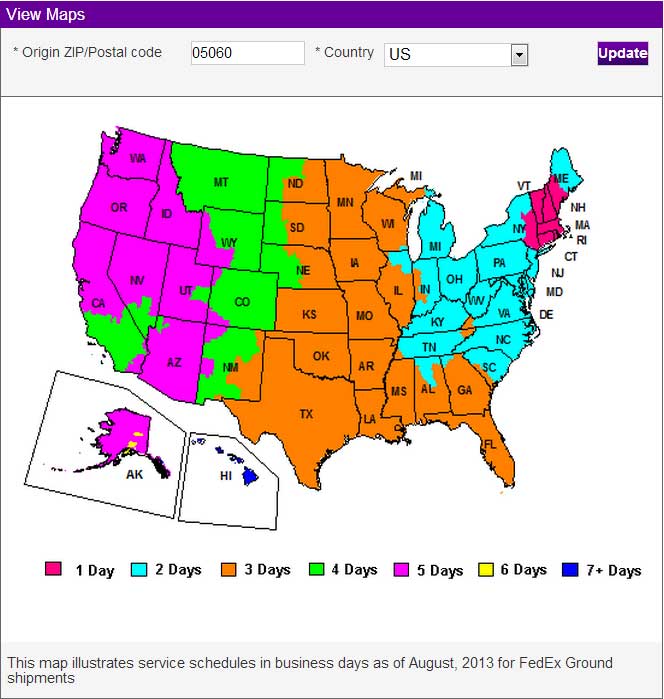
UPS Ground Delivery Zone Map:



- Low Prices
- Knowledgeable Support
- 100K+ Orders Shipped
- Free Shipping
- Bulk Discounts
- 2,000+ 5-Star Reviews

LEDSupply is a trusted provider of engineered LED lighting solutions, serving OEMs, integrators, contractors, and lighting professionals with technical expertise, application support, and carefully curated high-performance products. Backed by decades of industry experience, our team helps customers move from components to complete lighting solutions with confidence. Learn More


Shipping
LEDSupply does NOT profit from the shipping or handling of your order!
Orders received before 3PM EST will be safely packaged and quickly shipped the same business day. If your order is NOT shipped the same business day, LEDSupply will offer a 5% discount off your next order.
All orders SHIP FROM:
296 Beanville Road
Randolph, Vermont 05060
See respective ZONE maps below for SPECIFIC delivery time to your location:
Any order that does not qualify for free shipping, will by default include a discount of equal value to the free shipping offer.
The shipping offered is meant to provide the widest variety of shipping options at the lowest price:
- FREE USPS First Class SHIPPING on orders under 13oz & >$49.99
- $5.99 USPS First Class on orders under 13oz & <$49.99
- $15.99 2-Day SHIPPING on orders under 2lbs
- $11.99 GROUND SHIPPING on orders under 2lbs
- $39.99 Standard Overnight SHIPPING on orders under 2lbs
- $49.99 Priority Overnight SHIPPING on orders under 2lbs
- Real-Time Rates are calculated for all International shipments
- *Base Rate + $1.99/lb for orders over 2lbs
USPS Priority Delivery Zone Map:
FedEX Ground Delivery Zone Map:
UPS Ground Delivery Zone Map: